Fashion has changed a lot over time, and we have really been on an interesting journey through the years in terms of where fashion was and what fashion is today. In the beginning, fashion was about sketches being created by hand and using a swatch from the fabric to create designs, with master tailors using their magical skills to create the garments needed.
Today, if you were able to go visit any design studio or showroom, you would see technology placed right next to mood boards and mannequins – this is the world we are living in today. The really exciting thing about all of this for students and others looking for what their options look like is still to come!
The traditional fashion designing, the kind we all grew up with, is still all about the creative skills and so on. Fashion technology, on the other hand, adds this whole other level of knowledge to it. And I think it’s this combination that really makes you future-proof in a field that’s constantly reinventing itself.
This is exactly why this whole debate around fashion design vs fashion technology has become such a hot topic today, whether you’re a fresh Class 12 pass-out trying to figure out which course to join, or a working professional trying to make a change. And of course, the pay factor is also something we’ll be discussing.
What is Fashion Technology?
Fashion technology, combined, is a union of all the creativity and innovation coming together for a common goal. It is a love child of creativity and innovation combined to create fashion technology meaning in the modern digital age, bringing fashion into the digital age and changing the way we create fashion.
Fashion is not just what it looks like, but also how the product operates and how to get that product to the consumer more efficiently. Fashion technology, on the other hand, just walks in and says, “Hey, I’m fashion technology.” It’s about using technology to make it all just a heck of a lot more precise and a heck of a lot less wasteful.
- Textile Innovation: Fashion technology is all about creating completely new textiles that not only perform better but also last longer and weigh less on the environment.
- CAD (Computer-Aided Design): Instead of sketching it out and just hoping it’s going to work out okay, fashion technology is all about creating computer-aided designs.
- Wearable Tech and Smart Fabrics: This one genuinely blows my mind. Clothes that track your physical activity, control your body temperature, or connect you with the world of technology? It may sound like something from the future, but it’s happening now
And in real-world terms? The impact is already very visible. 3D printing is being used to build garment structures that’d be impossible to stitch by hand. AI is helping brands figure out exactly what style to recommend to which customer.
Virtual fashion shows are now a legitimate thing designers showcasing entire collections to a global audience without a single physical runway. That’s not the future.
About Fashion Technology
Fashion technology isn’t some niche corner of the industry anymore; it’s right at the centre of how the whole ecosystem now operates.
If you want comprehensive fashion technology details, the scope of it is honestly much wider than most people realise. When you look at how far technology has changed the fashion industry, it’s quite astounding:
- Retail: At a progressive retailer today, you may use a smart mirror to virtually try on clothes or use augmented reality to interact with the product.
- E-Commerce: The ability to receive eerily accurate “You may also like” recommendations is the result of A.I. technology and data analytics.
- Manufacturing automation, digital pattern creation, and improved supply chains. Think about how deeply tech has worked its way into different parts of the fashion world:
At a global level, companies are pumping serious money into fashion tech because frankly, if you’re not keeping up, you’re falling behind. The big names are already showing how it’s done.
Nike is deep into advanced manufacturing and smart wearables. Zara and H&M are pushing hard on sustainable materials and cleaner digital supply chains. These aren’t experiments anymore; this is just how top-tier fashion brands operate now.
Fashion Design and Technology
The evolution of fashion design and technology has been one of the most significant transformations in recent times, these two fields have become inseparable and will continue to do so, because it’s now impossible to think about either term as a stand-alone concept. When examining fashion technology design is about vision/design/feel story; Tech is about creating solutions using technology.
It wasn’t too long ago when the process of fashion design was something like this: a rough sketch on a piece of paper, a lot of back and forth, a lot of waste, and then finally, a product. Well, today it looks a whole lot different. Today, it is an idea, it is a digital design, and then it is a product.
Here is a quick look at the tools used to make this process possible:
- CAD Software: Fashion designers in India are able to create very detailed digital illustrations and technical drawings, all on a computer screen, and all in real-time.
- Pattern-Making Software: This allows a designer to take a design and translate it into precise patterns for a garment, eliminating many of the errors that used to slow a designer down.
- Fabric Simulation Software: One of the coolest tools, in my opinion. It allows a designer to see how a fabric will behave without ever cutting a piece of fabric.
The payoff from combining fashion design and technology is pretty tangible. Production cycles move faster because edits happen digitally, not on the cutting table. Material waste drops significantly since you’re not burning through fabric on multiple physical prototypes.
Fashion Designing and Technology
What’s really fascinating about the world of fashion right now is that, essentially, design and technology are no longer even two separate conversations. They’re essentially the same conversation. One brings the soul, the aesthetic, the mood, the culture, the trend instinct. The other brings the tools, the processes, the ability to actually deliver a vision. And the modern-day designer, more and more, is expected to be fluent in both.
The description of a fashion designer’s work has, I think, quietly but significantly shifted. A few years ago, it was like, “Can I sketch well? Can I see well? Can I understand silhouettes?” And if the answer’s yes, then, okay, cool. But today? Yeah, that’s all still part of it, but there’s a whole lot more sitting on top of that. They’re expected to be comfortable with technology, expected to understand the production process, and expected to understand consumers. They’re not just designing alongside other designers anymore. They’re designing alongside people from other disciplines.
What does it actually take to be a successful player in this world? Well, a few things need to come together.
- Creative thinking, of course, is still the heart of it all. The trend instinct, the original concept, the strong design vision. All of that’s still there.
- The technical knowledge of fabrics, of construction, of what’s actually possible. You can’t really design in a bubble.
- The technical knowledge of software. This is where it gets a little more complicated. Designers who have succeeded to this point are those who have graduate in fashion designing and understand how to hold creativity and technical ability together. To me, this is a very strong combination.
What is a Fashion Technology Course?
A fashion technology course, at its heart, is a proper academic program designed to deliver the entire package, the creative skills and the technical knowledge required by the fashion industry today.
To understand all fashion technology course details properly, The entire point of it is to bridge the gap between having a fantastic fashion idea and being able to execute it in the real world, whether it’s on the factory floor, in a design studio, or in a management role.
Now, these courses are not necessarily a single format. Depending on where you are in life and what you want out of a career, there are different types of fashion technology courses. So, you have:
- Diploma Courses – These are shorter courses. They’re more hands-on and practical. A good option if you want to get into the fashion industry quickly.
- Undergraduate Programs – The big one is a B. Des or a B. Tech in Fashion Technology. It’s a more detailed program, covering both the creative and technical aspects of fashion technology for a duration of 3-4 years.
- Postgraduate Programs – If you want to specialise further, you have fashion management, textile technology, or garment production. It’s for a duration of 1-2 years.
What is a Fashion Design Technology?
Fashion design technology is an example of an industry that does not belong in just one box, and that’s the reason for discussing the industry. It’s not a pure art stream nor a pure technical stream. It sits right in the middle, doing the unglamorous but absolutely critical job of making sure that a designer’s vision doesn’t just stay on paper.
This difference becomes really clear when you look at how fashion design technology operates across different ends of the market:
- Mass Production: Volume is everything here. Technology is what allows a design to be replicated across ten thousand units and still maintain the quality of the design and the fabric waste in check. Take away the technology, and the whole business of fast fashion just collapses rather quickly.
- Couture and High-End Fashion: A completely different equation. Here, success is based on how well you can create one item, rather than how many can be created. Technology plays an important role in aiding the precise construction and hand-finishing of garments, giving every garment its own distinct edge.
So whether it’s a kurta that will cost you 500 bucks from a high street brand or a garment that’s strutting down the runway with a price tag that will make your eyes water, fashion design technology is somewhere in the background, making it all happen.
Difference Between Fashion Designing and Fashion Technology
Fashion is a big business that has a lot of different areas of employment. Before you begin working in the fashion industry, it is critical to evaluate the difference between fashion technology and fashion designing, as well as the general distinction between fashion design and fashion technology.
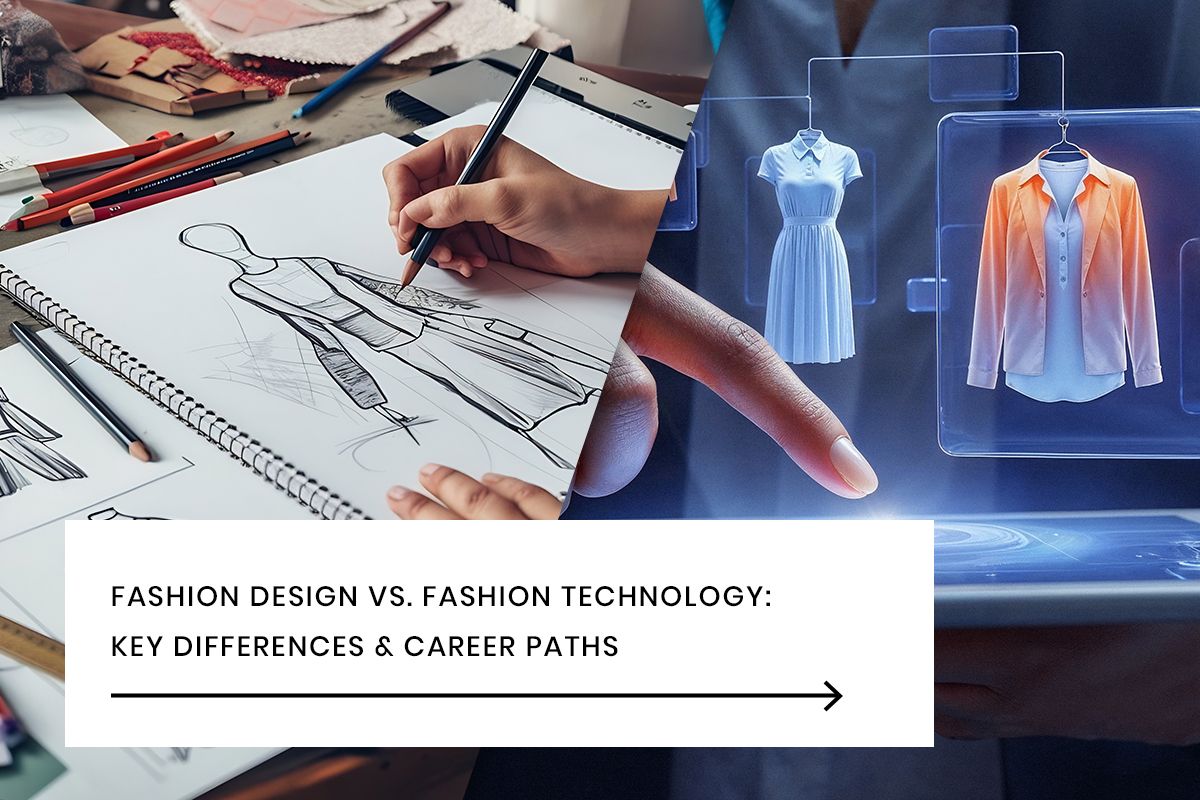
Understanding the fashion technology and fashion designing difference helps clarify that both disciplines go together fashion design has a stronger focus on creativity and artistry whereas fashion technology has a greater focus on technical aspects and production. To demonstrate this distinction, below is an overview of the differences between these disciplines:
Aspect |
Fashion Designing |
Fashion Technology |
|
Focus |
Creativity & aesthetics |
Technical & production |
|
Skills |
Sketching, styling, creativity | Engineering, CAD, technical skills |
|
Role |
Designer |
Technologist / Engineer |
| Tools | Manual + digital tools |
Mostly digital tools & machinery |
|
Output |
Design concepts, collections |
Finished garments, production-ready outputs |
Fashion Design vs Fashion Technology Salary
When selecting a career, it is also imperative to consider what your salary will be because many people base their decision regarding career choice on how much they think they will earn.
Fashion design and fashion technology are both examples of potentially high-paying careers, however, looking closer at fashion technology vs fashion designing, the way salary increases throughout your career path is uniquely different for each of the two disciplines.
Entry Level
- Fashion Designer salary: ₹2–5 LPA heavily dependent on your portfolio and which company you’re walking into.
- Fashion Technologist: ₹3–6 LPA technical roles tend to command a slight edge here, especially in manufacturing and production setups.
Mid Level
- Fashion Designer: ₹5–₹10 LPA to start; growing rapidly as you work with a well-known organisation or steadily build your own label.
- Fashion Technologist: ₹6–₹12 LPA to start; positions in production, quality control or supply chain have more potential for growth as compared to other areas.
Senior Level
- Fashion Designer: ₹15–₹30+ LPA; working for high-end, reputable designers with a large network of clients, who are well-connected within the industry; there are examples of designers who have gone beyond this figure or salary cap.
- Fashion Technologist: ₹12–₹25+ LPA; leadership positions within larger manufacturing companies and large global brands, as well as within other segments of the industry, are typically where higher salaries are most prevalent.
Career Opportunities in Fashion Technology
One of the most underrated things about fashion technology as a career choice is just how many directions it can take you. It’s not a one-track field and that’s genuinely exciting if you’re someone who likes having options.
On the more established side of things, some roles have existed for a while but have evolved significantly:
- Fashion Technologist: works right at the junction of design and production, making sure garments come out the way they’re supposed to, on time and up to standard.
- Apparel Production Manager: keeps the manufacturing side running smoothly. Timelines, costs, quality all of it lands on this person’s plate.
- Textile Designer: focused on the fabric itself. Creating new prints, experimenting with materials, pushing what’s possible in terms of texture and finish.
- Fashion Merchandiser – More customer-related positions involve determining which product lines are trending, how to market different products, and what sells and why.
- Quality Analyst – The professional who ensures the finished product meets the promise made. Maintaining consistency is their entire job.
- And there are new and growing positions as brands are under pressure to become more environmentally friendly:
- Eco-Friendly Designer: As companies are becoming increasingly scrutinized regarding their impact on the environment, individuals who have experience working with eco-friendly fabrics and sustainable production methods will become highly sought after.
- Wearable Technology Designer: Establishing textiles that track exercise, creating smart clothing/fabrics or clothing/fabrics that offer more than just looks.
- Virtual Fashion Designer: Building digital wardrobes for gaming systems, social media platforms, and virtual worlds; although the virtual fashion industry sounds small, its growth is rapidly outpacing most people’s expectations.
In terms of where these professionals actually get hired, fashion brands obviously, but also e-commerce platforms (which need people for merchandising and customer experience), and textile companies looking to innovate on the materials side.
Bottom line: fashion technology isn’t a narrow career path. It’s a wide one, and it keeps getting wider.
Skills Required for Fashion Technology
If you’re serious about building a career in fashion technology, there’s no single skill that’s going to get you there it really does take a combination of things working together. Technical knowledge, creative thinking, and at least a basic grasp of how the business side operates. All three matter.
On the technical side, CAD proficiency is pretty much non-negotiable at this point. Design and production workflows have gone digital, and if you can’t navigate these tools creating patterns, building prototypes, working with digital illustrations you’ll find yourself at a disadvantage fairly quickly.
Equally important is a solid understanding of textiles: what different fabrics are made of, how they behave, how they hold up. This isn’t just academic knowledge it directly affects the decisions you make on the job, from material selection to quality outcomes.
But here’s what a lot of people underestimate the soft skills are just as important, sometimes more so:
- Creativity: Fashion lives and dies on originality. Being technically sharp is great, but if you can’t bring fresh thinking to the table, you’ll plateau.
- Problem-solving: Production is messy. Designs don’t always translate cleanly into manufacturing reality. Materials behave unexpectedly. Timelines slip. The ability to think on your feet and find workable solutions is something employers genuinely value.
- Communication: You’re rarely working in isolation in this field. Designers, manufacturers, and business teams, you’ll be bridging all of these conversations regularly. Being able to clearly explain a technical constraint to a creative or a design requirement to a production team is a skill that makes everything run more smoothly.
The professionals who go furthest in fashion technology tend to be the ones who’ve built across all of these areas, not just the ones who are strongest in any single one.
Conclusion
Fashion technology is redefining the way the fashion industry operates by blending creativity with innovation and technical expertise. Throughout this guide, we explored what fashion technology is, how it differs from traditional fashion designing, the role of fashion design and technology in modern workflows, and the wide range of career opportunities available in this field. We also looked at fashion design courses, required skills, salary comparisons, and the future potential of this rapidly evolving domain.
Choosing between fashion design and fashion technology ultimately depends on your interests and strengths. If you are passionate about creativity, styling, and trends, fashion design may be the right path.
However, if you enjoy combining design with technical processes, problem-solving, and innovation, fashion technology offers a more versatile and future-ready career.
With advancements in AI, sustainability, and digital transformation, the future of fashion technology looks incredibly promising. The demand for skilled professionals is only expected to grow as brands continue to adopt new technologies and optimise their operations.
FAQs
1. Which is better, fashion design or fashion technology?
A. When comparing fashion designing and technology, it depends on your interest fashion designing suits creative minds, while fashion technology offers a blend of creativity and technical career opportunities, often influencing fashion design vs fashion technology salary as well.
2. What is the difference between fashion design and technical design?
A. The difference between fashion design and fashion technology or technical design is that fashion design focuses on concepts, while technical design ensures garments are structured, functional, and ready for production.
3. What is fashion and design technology?
A. Fashion design and technology refers to the integration of creative design with technical tools and processes, which is a core part of fashion design technology today.
4. What is the difference between the Bachelor of Fashion Design and the Bachelor of Fashion Technology?
A. The key difference between fashion designing and fashion technology at a degree level is that BFD focuses on creativity, while BFT, often part of a fashion technology course, includes production, textiles, and industrial processes.
5. What do fashion technologies do?
A. If you’re wondering what fashion technology is or about fashion technology, it mainly involves using tools and systems to improve design, manufacturing, and overall efficiency in the fashion industry, which falls under fashion design & technology.