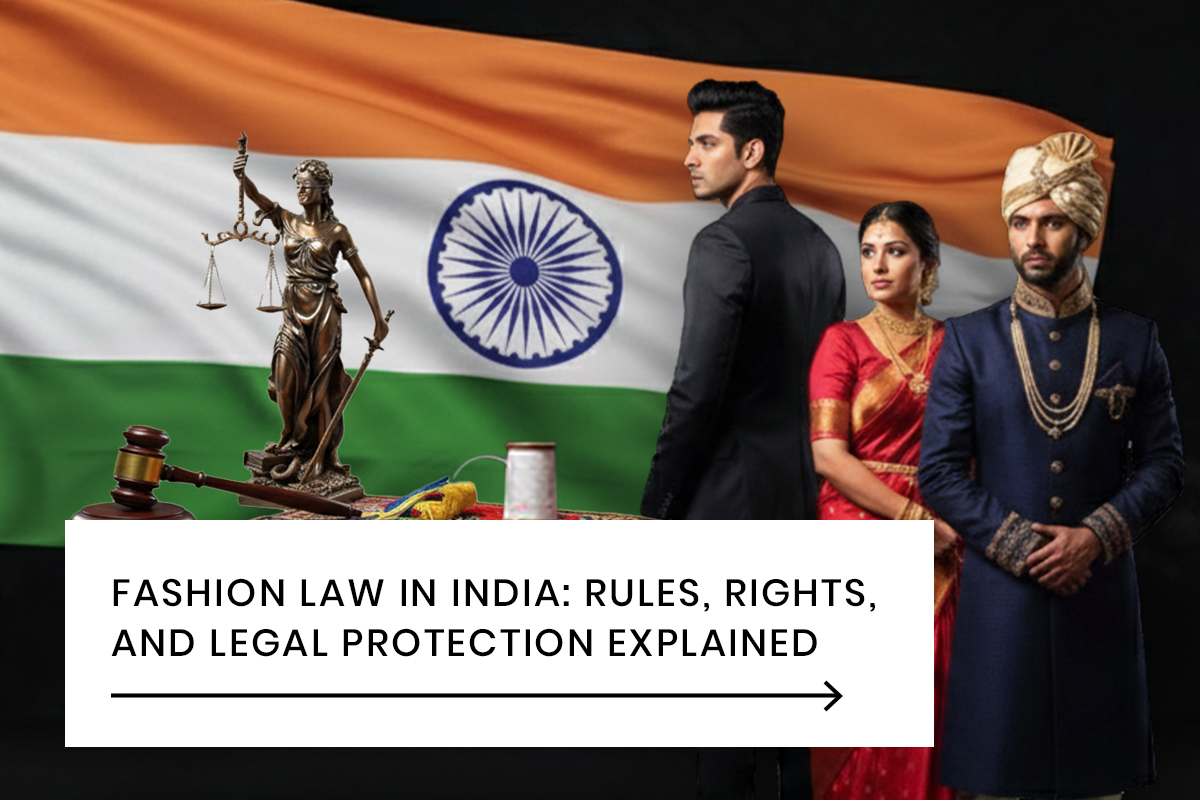
The Indian fashion business is a convergence of art, business, culture and compliance. Be it heritage handloom clusters, luxury couture houses, fast fashion retailers or digital-first design startups, the ecosystem is now far more mature and complicated. Legal issues come with this growth. Designers have to defend their intellectual property works. Producers are required to meet environmental and labour norms. Retailers are required to comply with consumer protection legislation. Digital labels need to comply with data protection and online marketplace regulations too.
While India lacks a comprehensive statute entitled “Fashion Law,” the industry is governed by a series of laws. These legislations are related to the ownership of intellectual creations, brand protection, industrial production, sustainable development, labour welfare, advertising code of conduct, digital business, etc. Fashion professionals with a well-informed understanding of the legalities can confidently create and run safe and compliant businesses, while still preserving their creative capital.
For aspiring designers and fashion entrepreneurs looking to understand both the creative and regulatory sides of the industry, institutions such as KIDAT provide structured exposure to fashion education and industry realities.
What are the various relevant acts and rules regulating fashion law in India currently?
The fashion law of India is based on many legislations. From intellectual property to environmental responsibility, each law has a different facet of the industry and a focus area.
The Copyright Act, 1957 and creative expressions
Artistic works are protectable under the Copyright Act. The Copyright Act offers protection to the original artistic work. In the world of fashion, these artworks, among others, can be hand-drawn and digitally drawn sketches, textile surface patterns, embroidery designs, graphic designs and even design renderings. Originality is identified as the pivotal requirement in the law. The author must show a modicum of “skill and labour and creative judgement.”
Copyright protection is automatic on works the moment they are created. Registration is not compulsory but is advisable as it increases evidentiary value in court proceedings. The protection is commonly extended for the life of the author with an additional 60 years.
You need to keep in mind that artistic expression, rather than functionality, is what copyright protects. A floral print designed by a designer may be protected. But a general idea, like a round neck t‑shirt or a simple pleated skirt, is not protected as it’s practical or it’s common. The law does not grant a monopoly over ideas or even useful clothing items, he explains.
Another important issue is the restriction on industrial reproductions. If a work of art is applied to an article by industrial methods and is reproduced in more than a certain number of copies, such application may destroy copyright protection for the fabric unless the pattern has been registered under the design act. This interface of design and copyright protection is at the heart of fashion law strategies.
Protection of Industrial Designs under the Designs Act, 2000
Visual aspects of industrial products are protected under the Designs Act. FashionCommitted to shaping the future of design, fashion and beauty, the TeamJack team has a proven track record in designing and delivering products that do not fit the shape, configuration, pattern, ornamentation, or grouping of lines and colours applied on attires or accessories.
Rights cannot be obtained without registration. It should be novel and original. Before you apply It is important that your design has not been previously published in India or anywhere in the world before the date of filing.
The owner of the copyright has the exclusive right to exploitation for ten years from the date of registration, which can be renewed for five years. The trade in the goods bearing the registered design is also infringed if, during that period, the goods bearing the design are made or sold without authorisation.
This statute is certainly one that we pay special attention to for designers offering unique silhouettes, tailored pieces, extraordinary accessory shapes and/or patterns that visually distinguish the brand.
Protection of trade mark under the Trade Marks Act, 1999
In fashion design, the branding of the company can be worth more than the clothing itself. The Trade Marks Act provides protection for the manufacturer or service provider [{thereof1}} trade mark] which in turn covers the names, logos, labels, signatures, monograms, and other such codes which make one’s brand unique.
Registration of a mark gives an exclusive right to use the mark in relation to the goods. Fashion brands usually file applications in classes which are typically related to clothing, footwear, headwear, jewellery, leather goods and retail services. Consumer Goods Trademark protection can also help counter the sale of counterfeit goods and erosion of our clients’ brands. It also permits you to seek recourse against companies that produce names or logos that are confusingly similar to your own and contribute to consumer confusion.
Certain fashion marks may also be widely known in due course, which provide broader protection even outside of the registered classes.
Rules framed under the Geographical Indications Act and the protection of heritage textiles
India’s rich textile heritage is a cornerstone of its fashion identity. The GIs Act enables a particular good originating from a specific place to be protected if it derives its qualities from that place.
Heritage fabrics like Banarasi brocades, Kanchipuram silks, and a host of other are allocated region based weaves get this benefit. Only producers from the registered area have the right to use the name.
This legislation protects the rights of communities and cultural identity, while tackling the issues that arise with traditional craft names being used by unrelated producers.
Consumer Protection Act 2019 and retail responsibility
The Act controls the practices of advertising, quality of goods and services, redressal of consumer grievances, etc. Fashion labels need to be sure product descriptions are honest and not deceptive. Files related to fabric quality, sustainability or origins of fabric are not even supposed to be accurate.
E-commerce platforms are covered under the Act too, and have to make sure they have transparent return policies and effective redressal mechanisms. Noncompliance might result in consumer grievances and/or penalties.
Textile labelling requirements
The Indian Textile Labelling regulations mandate that the fibre composition, details of the manufacturer or importer and care instructions are communicated. These disclosures allow consumers to make more informed decisions when purchasing goods and shield them from deceptive practices. For fashion companies at scale, lecturing on correct labelling is a fundamental regulatory responsibility.
Environmental regulations for fashion
Textile production has water-intensive steps and chemical processing. Environmental legislation applies to matters such as the discharge of effluent, the disposal of solid waste, and the control of pollution.
The manufacturing units should also ensure the acquisition of requisite clearances like consent to establish and consent to operate, and to install an effluent treatment plant. Non-compliance can lead to closures, financial punishments and damage to reputation.
Third-party factories and brands have to do their homework to be environmentally compliant.
Labour codes and worker protection
The consolidated labour codes in India cover wages, workers conditions and social security, among others. The factories must pay minimum wages and provide safe working conditions.
Employers are obliged to make such contributions to social security schemes as provident fund and employees State Insurance, as applicable. Adhering to these standards helps safeguard employees and mitigate legal exposure for companies in the fashion industry.
How has the scope of fashion law expanded to include digital designs and AI-generated prints?
Significantly, the digitalisation of fashion has broadened the scope of legal protection. Designers are increasingly creating work via software, collaborating online, and selling on virtual platforms.
Protecting digital artwork
Digital sketches, computer prints and three-dimensional renderings can be considered as artistic works as long as they are sufficiently original. The protection is independent of medium – you will have the same protection in case you write it on paper, use an Etch-a-Sketch, or draw it on the beach. It’s the human element, the creativity. Digital creators need to keep records of their creation process, including drafts, time stamps and other information that is important to prove authorship in case of disputes.
Artificial intelligence and authorship controversies
AI tools can now produce patterns, prints, and visual content based on textual descriptions. It also raises complicated authorship issues.
Indian copyright law only recognises human authorship. If the designer is “substantially involved” in the creative process, then authorship is possible. However, there is legal uncertainty in relation to fully machine-generated work without human involvement.
Roughly speaking, the Indian judiciary would tend to analyse whether a work is sufficiently original to warrant protection.
Digital fashion and virtual goods
Fashion brands are now designing digital clothes for virtual environments and online adventures. Trademark rights are also applicable to digital uses of brand names and logos. The use of a fashion brand in online stores or games without permission may be infringing.
As digital retail sales ascend, the law is under pressure to evolve to protect virtual, as well as physical, assets.
Online marketplaces and enforcement
The majority of platform websites appear to allow you to shop for fashion from third-party sellers. Owners of intellectual property need to keep an eye on these sites for counterfeit goods or unauthorised reproductions.
Platform must comply with valid takedown notices: The intermediary liability norms also mandate platforms to comply with valid takedown notices. With the rise of digital commerce, legal strategies must evolve to identify when the virtual assets transcend physical goods. Acting before violations occur has now become an important feature of contemporary fashion law practice.
What is the mandatory law on clothing in India for sustainable production and ethical labour?
India does not have a “mandatory clothing law” to ensure sustainable production and fair labor in the textile industry. Instead, they clothe and protect themselves under a patchwork of federal laws regulating the environment, waste, labor, and industry standards, which will be getting more stringent in 2025-26 for the big firms.
Sustainable Manufacturing Regulations
The production of textiles is regulated under the Environment (Protection) Act, 1986, which includes provisions for pollution control, treatment of effluent, and zero liquid discharge (ZLD) in the dyeing and chemical units. ZLD is nothing but a recycling brand of 90-100% water in the processing units. Hazardous and Other Wastes Rules, 2016 (amended) – Textile sludge is now categorized as hazardous waste and can only be treated and disposed of in an authorized way.
The 2026 Solid Waste Rules (effective April 1, 2026) will impose Extended Producer Responsibility (EPR) for clothing brands to recover and recycle post-consumer textile waste equivalent to 10 to 30 percent of the sales volume per year moving to 100% in 2030; otherwise, a penalty of ₹10 lakh per infraction shall be levied for non-adherence.
The 2025 Sustainable Fashion (Promotion and Regulation) Bill—under review by Parliament in early 2026—imposes the converted 60% mark for eco-friendly materials (organic cotton, recycled polyester as per GRS/GOTS standards), 40% recycled content in at least 50% of lines, while manufacturing must reduce water usage by 20% and emissions by 15% in lifecycle assessments. Ecodesign requirements include biodegradable packaging and digital product passports to enable traceability. Rewards comprise tax holidays for certified green factories; fines escalate to ₹1 crore, and suspension of the supply chain.
Ethical Labor Standards
The labor standards are based on four Labour Codes which were unified in 2020-2025: The Code on Wages 2019 (Minimum Wages ₹15,000/month for urban areas, payment on time), The Code on Occupational Safety, Health and Working Conditions 2020 (8-hour work shifts, ventilation, personal protective equipment (PPE) in establishments with at least 10 employees), The Industrial Relations Code 2020 (union rights, grievance reconciliation), and The Code on Social Security 2020 (Employee Provident Fund (EPF)/Employee State Insurance Corporation (ESIC) for employers with 10 or more workers, maternity benefits). Child Labour Act forbids employment under the age of 18 in the factories; violations result in a 2-year jail term.
Clothing export firms are now being heavily monitored in the new Labour Codes, calling for annual investigations by compliance, wage transparency, and third-party ethical certifications (e.g. , SA8000, Fair Trade) for EU/US retailers; more than 100 crore (US$12 million) must operate 100% worker traceability reporting, with 5 lakh (US$6000) for every infraction. The Bonded Labour System (Abolition) Act Prohibits Bonded Labor, which is enforced by district inspections.
How Are “Artistic Work” and “Industrial Design” Differentiated in the Fashion Laws of India?
In India, the line between an artistic work and an industrial design is not just one of scholastic interest. It affects the kind of intellectual property protection that one can get, the length of that protection, the formalities for registration, and the remedies available in the event of an infringement. This distinction can be increasingly important in the fashion industry, where creativity frequently merges with commercial scale.
This distinction is mainly governed by the Copyright Act, 1957 and the Designs Act, 2000. Although they both try to protect creativity, design law is at the intersection of fashion and industry, while copyright is at the intersection of art and design.
What Does “Artistic Work” Mean Under Copyright Law?
Section 2 “artistic work” In relation to a work is a painting, a drawing, a diagram, a map, a model, a sculpture or a collage, irrespective of whether it is two-dimensional or three-dimensional; whether it is made by hand or by an automated process; whether it is useful or purely artistic; and includes works of artistic craft. It is important to realise that you do not require it to be beautiful to be eligible for copyright protection. Even a simple sketch, design or drawing can be taken as long as it is original.
Artistic Goods in Fashion may include, for example:
- Freehand sketching of clothing designs
- Stand-alone artworks that are textile prints
- Embroidery designs that are independently created from mass production
- Graphic designs on garments
Copyright protection subsists as soon as it is created. There is no compulsory obligation to register; however, registration enhances enforcement. The protection period usually lasts for the life of the author and 60 years.
Copyright protection exists in the expression of an idea in an aesthetic form; the principle behind this is straightforward. It does not extend to the functional aspects of a dress, including the shape of a sleeve or a pocket’s practicality.
The Notion of “Industrial Design” in the Context of Design Law
On the other hand, it is only those features of shape, configuration, pattern, ornament or composition of lines or colours which are applied to an article by an industrial process that are protected under the Designs Act. It’s not about the artwork — it’s about how that visual feature is applied to a manufactured product. In the fashion world, it may be:
- The unique outline of a bag
- The surface design is printed on a domestic surface, which is covered in fabric and then used for mass production.
- The style of shoes
- The decorative designs on good accessories
To be protected by design law, filing is necessary. The design must be new or original, and it must not have been made available to the public before. Design protection under the Designs Act – Renewal Protection under the Designs Act of 1996 lasts for a term of 10 years, extendable for a further period of 5 years from the date of such expiration.
What are the essential steps to follow in a comprehensive Indian fashion law guide for new entrepreneurs?
Designing a fashion label in India is not just about having the right vision and marketing ability. But it calls for a disciplined legal base that safeguards intellectual property, manages regulatory risk and mitigates potential long term business risk. An all-encompassing guide on Indian fashion law for new entrepreneurs should take them through building a fashion business from start-up ball rolling through to growth by protecting their idea and converting it into a business. Entrepreneurs planning structured training in fashion management may consider specialised programmes such as the Graduate Diploma in Fashion Designing & Management, which integrates creative development with business, compliance, and industry exposure.
Choosing the Right Business Type
Step one is deciding on the best legal structure. This choice influences the exposure to liability, taxes, the level of compliance and the readiness for investment. Lots of independent creators sell as sole proprietors, but an ambitious startup CEO will most likely want to establish a Private Limited Company since it protect your personal liability and provides more credibility with investors, vendors, and marketplaces. The Companies Act, 2013, governs company registration. Incorporating also opens the door to more structured banking, contracts and financing. Getting the structure right from the start will save you a lot of money in restructuring.
Obtaining Trademark Rights on Brand Identity
Fashion brands often derive more value from their brand equity than from the products they sell. A unique name, logo, label or tag line needs to be legally protected before mass marketing or launch.
The Trade Marks Act, 1999, applies to the registration of trade marks. A clearance search is necessary before deciding on the final name for your brand to avoid any infringement issues. Make sure you’re also registered in the relevant classes for clothing, footwear, accessories and retail – it’s better to be safe than sorry! You risk other companies copying your branding and diluting your presence in the marketplace without registration.
Safeguarding Designs and Artistic Work
The Indian system of fashion law differentiates between artistic works and industrial designs. Original designs, fabric paintings and illustrations are protected by the Copyright Act, 1957. protection may lie with design law when a design is used on goods, and these goods – such as garments – are mass produced in excess of the statutory limit.
If a fashion entrepreneur intends to go for mass production of a distinctive surface pattern or clothing shape, he or she may desire to go through the registration process under the Designs Act 2000. Delayed registration may result in loss of rights to enforce them after the industrial production has expanded. Thus, a strategic intellectual property plan before entering into manufacturing agreements is critical.
Drafting Solid Vendor and Manufacturer Agreements
Most fashion houses contract stitching, embroidery, printing, or finishing to offshore units. In the absence of explicit agreements, questions of ownership can arise with respect to designs, moulds, patterns, and even unsold inventory.
Manufacturing agreements should also specify that all the intellectual property generated during the manufacturing process is owned by the brand. Confidentiality provisions cover sketches, tech packs, and supplier lists. Quality control requirements and delivery deadlines should also be established in writing to minimise the risk of business interruptions.
Compliance with Labour and Factory Law
Compliance with Labour is necessary if the production is done in-house or in captive facilities. Wages, working hours, occupational health and safety, and welfare of the employees are in accordance with the Indian labour laws.
In relation to the size and nature of the business that you are conducting, you also may be required to comply with the Factories Act, 1948 and the corresponding labour welfare measures prescribed thereunder. Ethical sourcing is increasingly critical, not just for legal compliance, but also for brand identity, particularly in export markets.
Comprehending Environment- and Sustainability-related Regulations
Due to the environmental hazards associated with them, textile finishing, dyeing, and printing processes are controlled. Those engaged in these activities are required to observe pollution control measures, and these are incorporated in waste disposal regulations. There may be needed environmental clearances and the state’s pollution control approvals. With the growing salience of commercial sustainability, compliance with environmental requirements is also affecting investor sentiment and the eligibility for global commerce.
Following Consumer Protection and Labelling Requirements
Fashion items are subject to the same consumer safety and transparency regulations. The label should accurately reflect the fibre content, care information and country of origin. False advertising/sustainability claims lead to Consumer Protection Act, 2019 compliance.
Also, e-commerce sellers need to comply with the policies of the online marketplaces, return policies, and the redressal of grievances.
Tax Registration and Indirect Tax Compliance
No fashion industry has to log its taxes. Goods and Services Tax (GST) Registration is compulsory when the Turnover threshold is met or in case of interstate supply of goods.
Under the Central Goods and Services Tax Act, 2017, tax compliance relates to. Proper invoice, ITC management and timely filing are a must to avoid penalty. Export-oriented brands should also be well-versed in customs and duty regulations.
Securing Contracts With Influencers and Retailers
Today’s fashion brands rely on influencer collaborations, celebrity endorsements and multibrand retail partnerships. These agreements must be in writing and outline payments terms and ownership of the content produced, the extent of any usage rights and any exclusivity provisions.
Good documentation helps avoid disputes over campaign rights, use on social media and reputational risk.
Preparing for Enforcement and the Resolution of Disputes
Preventive measures notwithstanding, there may be disputes concerning counterfeiting, trademark infringement, breach of contract, or dues not paid. Businesspeople also need to be aware of the remedies available to them, such as civil injunctions and damages, as well as criminal enforcement, in the intellectual property arena.
Early rights registration makes enforcement more effective and increases the chances of obtaining a fast response from the court.
Developing a Long-Term Legal Strategy
A restatement of fashion law includes linked but unconnected formalities of registration. It prompts businesspeople to adopt legal thought as part of business planning. From product development to scaling to international expansion, legal compliance can be considered a financial best practice rather than a necessary evil.
The secret to success for fledgling Indian fashion entrepreneurs lies in acknowledging that both innovation and business take place within a definable set of rules. A legally strong foundation enables enough time to build a sustainable business, attract investors and/or continue with a daily regimen in an ever-demanding fashion market through brand ecommerce.
Conclusion
Fashion law in India may not be governed by one single statute or a set of codified laws, but it is subject to various legislations of intellectual property, consumer, labour, environmental and commercial laws. The Copyright Act, 1957, Designs Act, 2000 and Trade Marks Act, 1999, inter alia, govern the way in which creativity is protected, brands are built, and products are manufactured and sold responsibly.
Being legally aware as a designer and business owner is more than just a matter of compliance. Fashion law should be about safeguarding innovation, managing conflict, and creating a fashion business that is working commercially and legally, in an industry that is changing so quickly.